Klaus Kollmai learned early in life how to identify and solve problems.
The task couldn’t have seemed much greater for a young German boy who landed in Wichita on the last of a three-leg, transatlantic flight from Frankfurt in 1956. He enrolled in second grade with little to no English knowledge the following day at Alcott Elementary School.
But with a patient teacher and his own resourcefulness, Kollmai made progress.
“There were no bilingual classes,” Kollmai said. “I’d go home in tears. I’d stand in front of the mirror and try to come up with American gestures.
“About six or seven months in, I was pretty well-versed in smaller conversations and picking up vocabulary. I watched ‘Little Rascals’ and cartoons to learn the language, and benefited from being around people who were patient with me.”
Through an often-challenging childhood, Kollmai developed a persistent streak. One that allowed him to navigate through a period as a temporary high school dropout to become a college dean’s list honor roll student, and eventually a high school educator and administrator.
During that journey, Kollmai, a member of this year’s Kansas State High School Activities Association Hall of Fame class, helped soccer – the preferred sport of his native Germany – gain a foothold at the high school level in the Wichita area and across the state. Those efforts earned him the nickname “Mr. Soccer,” a moniker he accepts with pride.
“When they say that, it’s kind of emotional,” said Kollmai, who started the soccer programs at Wichita South in 1977 and at Newman University in 1984 before embarking on a 32-year career as a high school and college soccer official. “The first time somebody said it, it was probably something like, ‘Who do you think you are? Mr. Soccer?’
“But now, when it comes from your colleagues and even the kids, that’s when it means the most.”
The 76-year-old Kollmai hung up his whistle after officiating nearly 1,500 matches. And in 2020 he retired as Wichita USD 259’s hearing officer on disciplinary matters after overseeing approximately 13,000 cases for students ranging from preschool to high school seniors.
He currently serves part-time as a senior liaison – helping students get on track toward graduation – at Wichita South, where he taught, coached and served as athletic director at various points during his tenure from 1977-89.
“What made him so successful in doing his job with (USD) 259 is Klaus didn’t really care what anybody else thought about him,” said J. Means, retired athletic director for the Greater Wichita Athletic League and Kollmai’s friend. “He was going to do what he thought was best, whether it came to a student, teacher or other administrators.
“Another way of putting it is Klaus earned a lot of respect just by being Klaus.”
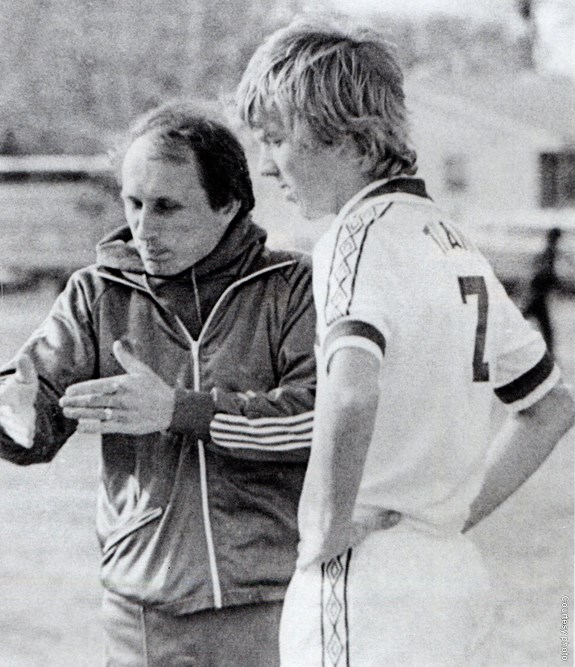 Klaus Kollmai started Wichita South's soccer program as a club sport in 1977
and helped it transition to the varsity level two years later.
Kollmai’s upbringing gave him a unique perspective for the myriad roles he held throughout his career in education.
Born in the southern part of Germany near Munich, Kollmai never knew his father and had a strained relationship with his mother. Before coming to the United States, he lived in Berlin with his grandparents in a home void of hot water, television, telephone and air conditioning.
Kollmai joined his mother in Wichita after she married his stepfather. After one year at Alcott, he attended Minneha School from third through ninth grade, eventually flourishing as a student as he prepared for high school.
But after receiving his U.S. citizenship in 1964, Kollmai enrolled at Wichita East. During a time Jim Ryun was making national headlines as a track star for the Blue Aces, Kollmai’s high school experience did not go well. He dropped out and returned to Europe.
“I came back over and ran around with a bunch of fools, smoking and drinking,” Kollmai said.
He eventually returned to Wichita, but his time away hindered his quest to enroll at several area schools. Kollmai passed a test that allowed him to complete his senior year in 1967 at Wichita Collegiate. He then turned his focus toward summer coursework that allowed him to enroll at Wichita State.
“I think there was a major correlation,” Kollmai said of his student and adult life. “I always felt like there was a stretch of my life where I had to prove to others that I’m really capable of doing things.
“I think anybody growing up takes a lot with them as you go to the next stages. I had no parental support, and I had to work through that.”
After graduating from WSU in 1971, Kollmai’s initial job offer as a German teacher fell through at Wichita Heights. He went to north central Kansas, teaching and coaching two years at the former Republic High School before spending one year at Halstead, helping start its girls basketball program.
Kollmai then worked for three years at Kapaun Mt. Carmel, coaching and teaching German before moving on to Wichita South. In his first year with the Titans, Kollmai got then-athletic director Elmer Carpenter’s approval to start soccer as a club sport before getting Board of Education approval to make it a varsity sport in 1979.
That year, Kollmai started the Titan Classic soccer tournament, which has continued for 45 years.
“I loved it at South,” Kollmai said. “I got the kids to buy in. I got the kids to accept that you can still go to work at night – which was an important thing there – and still buy your car. But give me an hour and 45 minutes on the field, and I promise you we’re not going to waste any time.”
Kollmai started soccer as a co-ed program during his time at South, which eventually added a girls program. He led both teams, taking the boys to the state semifinals in 1988 and an all-class runner-up finish to Wichita North in 1989.
After serving as athletic director late in his South tenure, Kollmai moved to Wichita North as an assistant principal. At that time, he also transitioned from coaching to officiating, beginning a career that saw him work not only on the field but assisting KSHSAA administrators who oversaw soccer.
Kollmai was the lead rules interpreter for 10 years, conducting numerous clinics and meetings across the state. He also spent four years as a section representative on the National Federation of High School’s soccer rules committee.
While working high school, junior college and college matches, Kollmai served in other educational roles. He spent two years as an associate principal at Wichita Heights and four years as principal at Campus before returning to USD 259.
After tenures at Sowers Alternative High School and the now-defunct Judge Riddel Boys Ranch, a youth residential center for troubled teens, Kollmai started his 15-year run as the Wichita school district’s hearing officer.
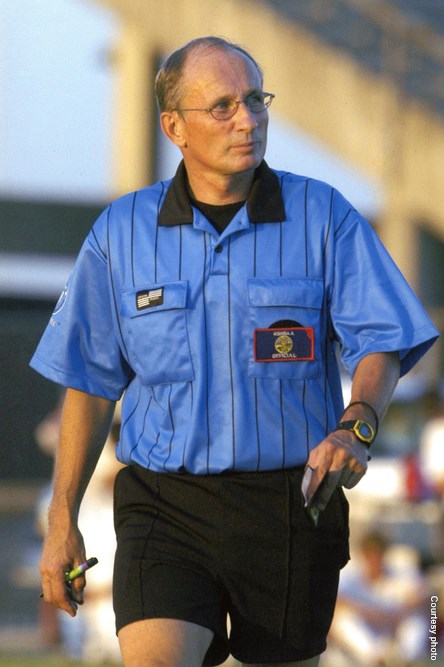 Klaus Kollmai officiated soccer at the high school and
collegiate levels for 32 years.
Kollmai said his roles of supervising disciplinary hearings and officiating soccer matches went hand in hand.
“A lot of people who know me said, ‘How can you go through having had all that stuff happen in a hearing or as an assistant principal, and then you go and do a soccer game where it’s the same type of conflict?’” Kollmai said.
“In my opinion, they served each other. When I’m down here at a certain level from my job and then go out and officiate, I’m refreshed in a different arena. I think I learned to manage tough games as a result of being in those other roles.”
Kollmai worked as the center referee in 21 high school state championship matches. He was selected as Kansas Boys Soccer Official of the Year in 1992, 1997 and 2014. In addition to being inducted into Wichita South’s Athletic Hall of Fame, Kollmai is a member of the Greater Wichita Officials Association and Kansas College Officials Association halls of fame.
Around the time Kollmai was aiding soccer’s rise as a high school sport in Kansas, he also worked as a color commentator for the Wichita Wings, a professional indoor soccer franchise that enjoyed its heyday in the early-1980s.
“Back when Klaus was getting things started, not a lot of people around here knew much about soccer,” Means said. “Klaus was kind of that trailblazer. He had passion for it, and he never gave up giving back to the sport.
“I can’t believe he was still officiating when he was 70. He just never stopped giving back to the soccer community.”