As much as he was enamored with the sport when he was a young boy, track and field was never Mike Bradley’s true love when it came to athletics.
“Not even close,” he said. “My first love by far was basketball. I would have rather played basketball than eat, and I like to eat.
“I never really enjoyed running. And people would ask me, ‘How can you be successful without the joy of running?’ I didn’t enjoy running, but I enjoyed competing and I enjoyed winning. And track is what gave me that platform to experience winning.”
And to experience the lofty dreams he set for himself at a young age. A three-sport standout from Wetmore, Bradley became much more than a small-school standout during his athletic career.
He flourished in college at stops at Coffeyville Community College and Kansas State and then shined on the national stage as a member of the United States’ gold-medal winning 1,600 relay at the 1983 PanAmerican Games in Caracas, Venezuela.
A member of Kansas State’s Athletic Hall of Fame, Bradley is now a member of the Kansas State High School Activities Association Hall of Fame. He was selected to the hall earlier this school year and was officially inducted with a ceremony at the State Outdoor Track and Field Championships in Wichita in late May.
It was a fitting site for his ceremony as Bradley finished a stellar high school athletic career with a three-gold performance in his final state track meet in 1979, sweeping golds in the Class 1A 100, 200 and 400.
“Picking that was just so special,” Bradley said. “There’s no better track meet in the United States and we’re the only one that does all six classes, boys and girls in the same meet. Nothing compares to the Kansas State track meet and that setting was incredible. They treated me like an absolute king. … From the press release, to the video to the on-field presentation, it was amazing.
“I look at the people in the Hall already -- Thane Baker and my boyhood hero Jim Ryun and watching Nolan Cromwell and what he accomplished in his career. To be in a place alongside guys like that, it means a lot to me.”
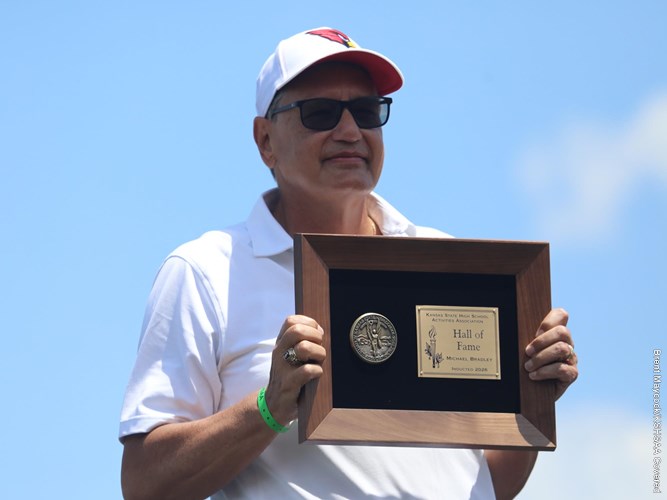 Mike Bradley won four state track and field championships in his career at Wetmore, setting 1A state meet records in the 100, 200 and 400 his senior season in 1979.
Long before Bradley became a small-school legend at Wetmore, he harbored dreams that extended well beyond the city limits of the tiny town in southeast Nemaha County nestled between Holton and Centralia, which no longer has a high school and has a current population of less than 400.
“I always had pretty lofty goals for myself,” he said. “I remember when I was young, I wrote papers on Olympic athletes. I remember writing one on Sebastian Coe, who at that time was the world record holder in the 800. I remember memorizing all the different Olympics – 1948 they were in Paris, 1952 they were in Munich, 1954 Montreal, 1960 Tokyo. I remember 1968, seeing Jim Ryun get beat by Kip Keino and being very upset about it as a 7-year-old boy. And then in 1972 when he tripped and fell and didn’t even make finals, being an 11-year-old kid crying because I was that invested in it.
“The Olympics were just so big at that time when I was growing up and I had high aspirations and it was to make it to that level.”
But as he got into competing in sports, his passions shifted. Basketball became his true love, followed closely by football.
And he starred in both. Bradley earned All-State honors his senior football season. In basketball, he led Class 1A in scoring both his junior and senior seasons, earning Kansas Player of the Year honors from the Wichita Eagle Beacon his senior season.
At that time, track was something he simply did to fill the competitive void during the spring. And his talents there were abundant as well.
He won his first state title in 1978, taking the Class 1A crown in the 440-yard run. When race distances were shifted to meters the following season, he left his mark in a big way at the state meet in Wichita.
In sweeping the 100, 200 and 400 state titles, Bradley posted the fastest time in any classification in the 400 with a 48.70, breaking the state meet record that had previously been shared by Ransom standout Nolan Cromwell and Bogue’s Dale Alexander at 48.90. He was the second-best among all classes in the 100 and 200 behind Wichita West’s Eugene Baker with both of his times – an 11.0 in the 100 and 22.10 in the 200 setting 1A state meet records.
His 100 and 200 records lasted two years until broken by Burlingame’s Mark Traphagen. His 400 record stood until 1986 when it was broken by Northern Valley’s Shane Baird.
What made Bradley’s accomplishments perhaps even more impressive is that Wetmore High School didn’t even have a track to train on.
“For training, we used to run around the block on the asphalt,” he said. “That was it. The closest track to us was about 20 miles away. We probably went there maybe once a year, before the state meet, so we never trained on a track. We never saw anything like Wichita ever until the state track meet.
“We didn’t have a clue about training. Didn’t have a clue about nutrition. Nothing about that. All the things they know today and the training that’s available to kids today, and the equipment. Oh my gosh! The shoes are night and day different compared to what we had. … I’m jealous of kids today for sure.”
As his success in track bloomed – he followed up his senior triple-gold performance at state with a time of 47.56 in the 400 at the 1979 National Junior Olympics that was the fastest 400 every run by a Kansas high schooler – Bradley also learned that was the avenue that was going to open up doors for his future.
“When college coaches started showing up to my high school events, it was always, ‘Yeah, you scored 50 points last night, but you’re also playing against 1A kids,’ or it was ‘Yeah, you scored four touchdowns last night, but you’re playing eight-man football,’” he said. “But the stopwatch doesn’t care how big your school is. That to me was a big deal because I got noticed from being at one of the smallest school in Kansas. Nobody paid that much attention to me until I started doing well in track. Track opened some of those doors. It doesn’t happen. You don’t come from a 1A school and have those kind of aspirations.”
Bradley used that avenue to become a three-sport star at Coffeyville. He earned All-Conference honors in helping the football team reach the NJCAA national championship game and helped lead the basketball team to the brink of the NJCAA national tournament.
Bradley transferred to Kansas State the following year to join their track program. He had talked with then-Wildcat basketball coach Lon Kruger about playing basketball as well, but was only given a walk-on offer.
“I thought real long and hard on it,” Bradley said. “The success I got in track and which one transferred on to the next level, it was definitely track. I made the difficult decision to concentrate on track. Basketball was still in my heart, but I knew in my heart of hearts that track was where I was going to have the most success.”
And he did. Bradlley became a two-time Big Eight champion in the 600, setting a Big Eight record in 1983 with a 1:08.89, and three-time All-American during his time at Kansas State and elevated himself into one of the top 400 runners in the nation.
In 1983, he ran the fastest time in the world indoors in the 600, setting a collegiate record. He earned a spot on the United States’ 1,600 relay team for the PanAmerican Games and teamed with Alonzo Babers, James Rolle and Eddie Carey to win the gold medal.
“It was amazing to be able to make a national team,” Bradley said.
With the Olympics on the horizon the following year in 1984, Bradley was poised to achieve that lofty goal of becoming an Olympian. In the year leading up to the formation of the Olympic team, Bradley had beaten relay teammate Babers three times.
But before the Olympic trials, Bradley saw his dreams shattered. Playing basketball in the Manhattan City Championships, he got his foot pinned to the floor as an opposing player fell on his leg. He suffered torn meniscus in his left knee.
A consultation with a doctor left him with two options: have surgery and miss six months – and the trials – or fight through the pain and continue to compete. He chose the latter as the only route he had to at least attempt to qualify for the Olympics.
But every hard workout Bradley put in, his knee swelled up. Limiting himself to such workouts once a week, he couldn’t maintain the high level of performance he’d competed at. At the trials, he fell short of his dream of making the Olympic team.
Babers, meanwhile, went on to claim the gold medal in the 400 and on the 1,600 relay at the 1984 Olympics in Los Angeles.
“My love of basketball cost me my track career,” Bradley said. “I missed the Olympic team by a year. Most people miss it by a tenth of a second, I missed it by a year. … There’s always that ‘What If?’ in the back of my mind. What if I had been able to train like I wanted to.”
Bradley never ran another race after the 1984 Olympic Trials. But his legacy as a Kansas great was already cemented.
“It’s unusual for somebody to come from a small school and accomplish what I did,” Bradley said. “It would have been more difficult to do it in another sport. … Track was something I did because it was track season, but I was able to succeed and use it to get to where I wanted to go.
“It’s very special to me,” Bradley said. “It’s important to me for two things more than myself. And that’s for my town and my grandkids. For them to experience, ‘I guess grandpa was pretty good.’”