In officiating nearly 20,000 games at just about every level imaginable – from town teams to NCAA Division II – George Ebert has become a well-known and well-respected figure all across north central Kansas.
The number of communities he’s touched throughout his career is countless.
And Friday night, Ebert gets a chance to visit a good number of them in a way he’s never done before.
Taking a rare night off from officiating, Ebert will be seemingly everywhere, all at once. A fixture on the field on Friday nights, Ebert instead will be airborne, flying over various football games in communities in which he’s spent the bulk of his 50-year officiating career.
“It’s a dream come true, something I had talked about doing when I retired,” Ebert said. “But my daughter (Heather Williams) surprised me with it on my birthday when I was out in the wheat field. I think 200 or so people knew about it before I did, but it was a great surprise.”
Ebert will be accompanied by his daughter, Heather Williams, longtime friend and co-worker Nathan Leeper (the former Olympic high jumper from Protection), KSNT-27 news reporter Caroline Soro and pilot Greg Burgess. The special flight – which will originate and end in Manhattan – was arranged by Manco Windows in Manhattan and Scoby Brothers (Luke, Jacob and Ben) in Sabetha.
After an initial flyover of his family farm in Flush, Ebert’s flight will take him over games at Riley County, Blue Valley, Valley Heights, Marysville, Hanover, Axtell, Sabetha, Holton, Royal Valley, Hayden, Hummer Sports Park, Silver Lake and Rossville with intentions of circling each contest before heading to the next town. Several of the games will make an announcement of Ebert’s visit.
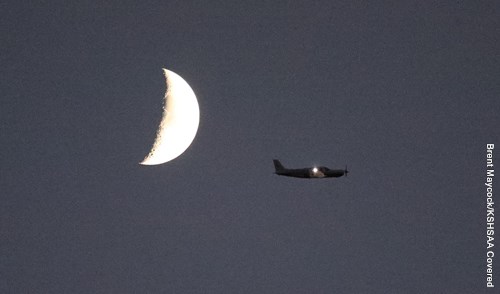 A plane carrying George Ebert on his tour of northeast Kansas on Friday night passes by the moon as it circled the field at Sabetha.
While most of the stops hold memories for Ebert, a couple have special meaning. The first game he ever officiated in 1974 was a football game at Axtell. He also officiated the first game at Hanover’s football field in 1980.
Those are just blips on a career that Ebert honestly never envisioned having after he graduated from Westmoreland in 1973 and enrolled at Kansas State.
“I was a pretty good athlete, but I couldn’t decide if I wanted to be an ag teacher or a coach,” Ebert said. “Lew Hitch was the superintendent (at Westmoreland) and his son and I were good friends and classmates. He said, ‘Hey, why don’t you guys enroll in Dave Laurie’s officiating class at K-State since you love sports so much?’’ We went up there and took the class.”
At that point, he was hooked. A bit to his surprise, given his view of officials during his high school career.
“I wasn’t very nice to referees,” he admitted. “They’d reach out for the basketball and I’d intentionally drop it and it would hit their foot and roll across the floor. I learned to gain a lot of respect for them once I started refereeing.”
Ebert and Hitch rounded up a couple other college friends from their class, got registered with the Kansas State High School Activities Association and put together their first football crew. None had ever officiated a game before stepping on the Axtell field in 1974.
Ebert has been going ever since, receiving his 50-year service plaque at last March’s Class 2A state basketball championships in Manhattan. He’s also served as league commissioner for both the Cottonwood Valley and Twin Valley Leagues for several decades, ending a 35-plus year run in the TVL two years ago.
“It just kind of snowballed,” said Ebert, who is 68 years old. “I Immediately I fell in love with it. One thing led to another and you just meet people whether it’s administrators, coaches, custodians, cheer sponsors, the players – everybody associated with high school athletics makes it just cool.”
Ebert’s passion for his second profession – he’s primarily a hay and cattle farmer – has kept him coming back year after year, even through a pair of serious accidents that threatened not only his officiating career, but his life.
He suffered a broken neck in a 1986 ATV accident that nearly left him paralyzed. Ebert came through that and returned to officiating only to endure an even worse accident in 2011 when a bull turned on him in a trailer and this time broke not only his neck but several ribs and “tore me up pretty good.”
Ebert was life-flighted to a nearby hospital with his life hanging in the balance.
“They didn’t know if I was going to pull through that night,” he said. “But the good lord said, ‘I don’t want you and the devil doesn’t want competition,’ so you guys are stuck on earth with me.”
Once again, he recovered and returned to the jobs he loves.
Ebert’s passion not only is reflected in his work, but in his dedication to recruiting others to officiate as well. Ebert estimates he’s recruited somewhere between 400-500 officials throughout his career, most of them coming from his contacts at Kansas State.
That’s where Buhler athletic director Justin Seuser first met Ebert.
“Me and my roomates started working games at the rec and got in touch with George,” Seuser said. “The first year we got into it slow and we met him at a sub-state. I was working some sub-varsity stuff and I just told him, ‘George, I’m ready to work varsity games.’ As a young pup you always think you’re a lot better than you really are, but he chuckled and went on.
“Sure enough the next fall rolls around and he calls and said, ‘Hey we’re doing a middle school game at Rock Creek. Show up. I want to see what you’ve got.’ So I did and from there on it was history. I worked on his Friday football crew and every high school football date with him and it just blossomed from there.”
Seuser eventually worked his way up to the college ranks in basketball, working two National Junior College Championship games. He recently stepped away from officiating to become the Coordinator of Officials for the Kansas Collegiate Athletic Conference and the Supervisor of Men's Basketball Officials for the Kansas Jayhawk Community College Conference.
He credits Ebert for his rise in the profession, particularly in the lessons learned early. Seuser said Ebert taught him that there’s a difference in calling a game and working a game.
“In officiating, yes you want to know your proper mechanics,” Seuser said. “You want to get plays right, our fouls and violations. But the ones that are successful are the ones that communicate and that’s communicating with every game-day personnel you come in contact with from the minute you arrive on site – coaches, players, admins. Because if you can communicate and develop rapport, it allows you to work through situations. As an official we may miss a play and I can tell you I’ve never met an official who’s refereed a perfect game. So the ability to work through those situations and to diffuse or to have a conversation that lets everybody understand.
“If you watch George, that’s where he excels. When he walks into a gym, you’d think he’s trying to be the mayor of Hiawatha or Rossville or wherever he’s at. Everybody and their dog know who George is. Now that’s because he’s older than dirt and has been doing this for 50 years. But you treat people right and it’s not any different in officiating than it is in our daily jobs. You go out and do the best job you can, treat people right and it’s very simple stuff that just has to do with life. I pattern a lot of things after how I’ve seen George do things and it impacts me not just in my officiating but in my job and profession.”
Seuser isn’t alone in seeing Ebert’s influence.
“It’s amazing, he’ll go to a ball game and it doesn’t matter where it is, there’s somebody there that he’s dealt with in one way or another, whether it’s officiating or his hay and cattle business,” said Josh Tanking, a longtime official in north central Kansas who worked periodically with Ebert as he was starting out. “It’s amazing how the two lines of things he does cross over with each other.
“He has gotten so many officials started. You can’t even put a number on it. He was so entrenched in the Manhattan area and with Kansas State. Every year he would bring 6, 8, 10 new officials. He does such a tremendous job and still does today.”
Ebert said recruiting new officials today is harder than it’s ever been. But he maintains the same approach he’s taken all along in doing his part to replenish the ever-diminishing supply of officials in Kansas.
“I always try to compliment them somehow, whether it’s how they’ve led their team or carried themselves on the field or court,” Ebert said. “And then say ‘Hey, have you ever thought about giving back to what made you so good? Ever thought about giving back to high school activities?’ They’ll say no most times, but I tell them to think about it and then I find a parent or coach to encourage them. They usually don’t bite unless someone else encourages them. Then they usually give it a try.
“Some like it, some don’t.”
Ebert has officiated football, basketball and baseball throughout his career, spending a little more than a decade working football and basketball games at the collegiate level before it became too time-demanding with his family and farm. During his prime, he estimated he was working roughly 20 games a week.
A balky right knee has forced him to give up baseball, but he still is a fixture on the football field and basketball court each high school season. He worked 42 consecutive state championship basketball games until last year, but still makes time to officiate at the middle school level as well. In fact, he’ll start another middle school basketball season next week.
“They all have their own unique appeal,” Ebert said. “I love football because you’re out there as a crew and people are a long ways away and most people don’t know football rules. Football is a lot of fun if you have a crew you like. Basketball you’re out there pretty much on your own and everybody thinks they know all the rules and they’re close.”
Ebert said he’s heard it all in his career and has countless stories he could fill a book with about his relations with various coaches over the years. One story that has stuck with him came from the 2014 Class 1A Division I girls state basketball championship between Hoxie and Valley Heights. Hoxie was in the midst of a run in which the Indians set the then-all-time state record for consecutive wins and was on its way to a 71-51 win over Heights in the title game.
“Jenny Yungeberg was the coach at Heights and they didn’t get off to a very good start,” he recalled. “And as I’m running by she goes, ‘George! They have won 70-some games in a row without you! They don’t need your help tonight!’ That was one of the all-time best lines I got. You just want to stop the game and laugh with them, but you can’t.”
Those kind of interactions he cherishes. And he also cherishes the time he’s spent with his officiating colleagues over the 50-plus years.
“The fellowship we have with our fellow referees, that fraternity of officials is tight,” he said. “We really have each other’s backs. It’s all about the kids – that’s what got me in it – but what keeps you in it is the friendships, without a doubt. You can’t put a value on it, you can’t write it down. It’s the brotherhood and the fellowship and the genuine concern for each other. We’re out there and everybody hates us, but we’re there as a team work it as a team and leave the court or field as a team. It’s a pretty special bond.”
Ebert credits his family – wife, Janelle, and children Heather Williams, Amy Jackson, Amanda Krohn and Brett Ebert – “for tolerating all the late nights I’m gone and keeping the farm going while I’m running around all over northeast Kansas.”
As long as his knee and health holds out, Ebert plans to keep going. He’s reduced his schedule a bit to be able to watch his grandchildren’s athletic careers, but is still going strong.
“I’ll keep doing it as long as I can,” he said. “Then I’ll back off and keep tyring to recruit officials because we need them.”
And in Seuser’s eyes, there no better person to do that than Ebert.
“He embodies what it is to give back to our communities, to our kids, to our coaches. He embodies what it is that we’re striving for in keep recruiting officials to get involved,” he said. “There’s not a better recruiter of young officials in the state of Kansas than George Ebert. He completely embodies why we do what we do – it’s purely the love of giving back, the camaraderie of working with other officials.
“He’s worked I don’t even know how many state championships in a row in multiple sports, but I can tell you he gets more enjoyment of seeing the guys and gals he brought along and got started to get their first postseason game or their first state championship game. I’ve been fortunate enough to have a lot of opportunities in my officiating career and it starts with George. He was the one who took a chance on me and gave me opportunities as a young pup at K-State and we still talk pretty much every week. I can’t say enough good things about him.”
NOTE: Story will be updated with pictures from Ebert's flyovers on Friday night.