After a six-year stint as athletic director at Doniphan West, Sarah Smith joined the Kansas State High School Activities Association as an Assistant Executive Director. Her primary responsibilities will be the administration of gymnastics, tennis, volleyball, bowling, unified bowling, the KSHSAA Hall of Fame and the Kansas Association for Youth (KAY) program.
Smith’s hiring was announced in March and she joined the KSHSAA full time on July 1.
The first month-plus on the job has been a whirlwind for Smith, soaking up everything she can as she prepares for the 2023-23 school year. Fresh off returning from late July’s KAY leadership camp, Smith took some time to sit down and talk about her journey to the KSHSAA, her adaptation to her new position and her experiences with the KAY program.
Q: Once you settled on education as a career, did you have a certain career path in mind?
A: “I kind of had to find my way. I loved athletics, loved sports and I knew I wanted to be involved in that somehow. I didn’t know if coaching was in my future, but I married into a coaching family and that was an immediate aspect of it,” said Smith, who served as an middle school head basketball coach and high school assistant basketball coach to her husband, Perry Smith, during her 11 years at Wetmore prior to their move to Doniphan West, where she was middle school head volleyball coach and high school assistant volleyball coach.
Q: At what point did becoming an administrator interest you and become your passion?
A: “My angle was really when I became an AD. I loved being an activities director. After being in education at that point for 15 years, that’s what I loved. I knew that’s where I wanted to go. I just wasn’t sure how it would work in the school setting I was in. At a small school, if you’re the AD, you also teach. I was fine with that, but I knew I eventually wanted to move away from teaching and just be an AD.”
Q: What inspired you to leave the school setting and join the KSHSAA staff?
A: “I had a few people reach out to me, but I was interested because I felt like this is really kind of a glorified AD position. You’re just working with all the schools across Kansas instead of the one where you are at. … I just looked at it as the ultimate AD position in a way. It was something I contemplated and had to make sure it worked for our family. I’ve always been at the school where our kids are at and where Perry is coaching at. As a family, we’re so school-centric and athletic-centric – that’s what we’ve always done.”
Q: What are the biggest things you learned being a teacher and AD at a small school that you’ve brought with you to this job that’s helped in this transition?
A: “How valuable these programs are to these communities, families and kids, really the kids. I see the value in extra-curricular activities and clubs and organizations. For some of our kids, that’s why they go to school. I see the impact they have. The kid is our focus, by all means. I see how much it can impact the school and community and bring people together. Especially for small communities, it’s a huge thing. But I would argue that it’s the same at a larger school, the impact it has on those kids.”
Q: Your previous experience has been almost exclusively at a Class 1A-sized school. Has there been an adjustment working with administrators from all different classifications?
A: “I feel like at every level, we have similar concerns. Large school, small school, your goal is the same.”
Q: You were able to shadow your predecessor, Annie Diederich, in the months between accepting the job and your start date. How beneficial was that and what has the learning curve been like in the first month-plus on the job?
A: “It helped a lot and Annie was very valuable in helping me and mentoring me. And when Fran (Martin) was here, helping me on the officials’ end of things. You don’t know what you don’t know. I think just learning all the things I need to communicate and send out. That’s all stuff I’ve done as an AD, but planning for events and putting things together – that’s not completely new, but it’s learning all the prep work that needs to go into stuff to get people at the school level prepared to go for the school year.”
Q: A handful of activities you are now the administrator for – gymnastics, bowling, unified bowling and tennis – are completely new with your previous schools not having offered those sports. Has it been easy to get up to speed on the knowledge of those sports?
A: “I’m still learning and I’m really relying on knowledgeable people in the office and in those sports. I’m just trying to take every bit in I can. It’s been fun just cracking the surface of it. I don’t know that there’s been a sport that I have not enjoyed in my lifetime, whether watching it or competing in it. I’m completely starting new with some programs I’m not familiar with. I’m very comfortable communicating with ADs, administrators and coaches, but it’s just learning the programs I’m administering. But I love to learn, no matter what it is, so that’s been exciting for me. I’ve always said if you’re not learning, you’ve peaked, plateaued. I also appreciate a challenge. I love to learn and I’m going to learn.”
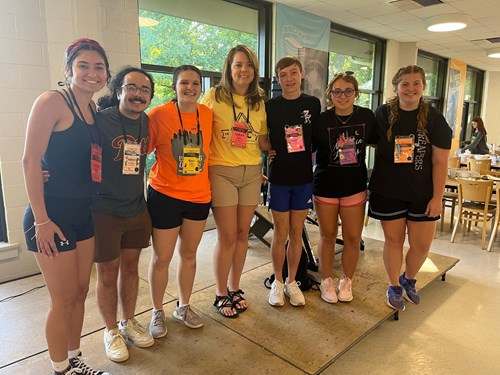 New KSHSAA Assistant Director Sarah Smith (middle) said she was rejuvenated by the recent KAY Leadership Camp.
Q: You got your first introduction to KAY at Wetmore as the club sponsor and then started the program at Doniphan West upon your arrival at that school. How important has KAY been to you and what appeals to you the most about its benefits in Kansas schools?
A: “The first year, I was hooked. There’s something about kids doing service and volunteering. There’s something special about it. You’re giving something to the person on the receiving end, but you’re getting something back as well on a personal level. It’s very fulfilling and rewarding. And kids don’t always experience that unless they’re part of a KAY program. For them to be able to have those experiences in helping others, trying to alleviate suffering, trying to make their community better, to help at the national level, it’s very rewarding. You got to see a different experience with the kids and I loved that angle of KAY. Just doing good things. A lot of kids need that.”
“Looking back when I got to Doniphan West, there was just something missing. We started that KAY program for the kids to see the impact they can have at that level. I think it creates an element that you realize there’s something bigger than yourself. KAY often brings kids together that may not otherwise. There’s a better understanding that everybody is struggling with something. It’s being kind to one another and it gives them the sense of doing something for others and there’s things bigger than yourself going on.”
Q: This was your first time at the KAY leadership camp. What was the experience like for you?
A: “It was a wonderful experience. I came back rejuvenated. It’s just a great camp. You saw kids that maybe wouldn’t interact in a normal setting and they do at KLC. They support one another and it’s really a setting you would love to take and plant in all of our schools. Seeing kids interacting, being kind, supporting one another no matter what. We have kids of various levels and involved in various activities at their schools and at KLC camp, they just interact so well together. It was a neat experience and on the last day, I was telling them, ‘Take these lessons back to your school and apply them. Be kind, include everyone and respect our differences.’ Because they do a great job of that there.”
Q: Is there one big thing that came out of the camp this year?
A: “We talked a lot about, ‘What is our why? Why are we doing what we’re doing?’ At KLC, there’s a reason we do everything we do. The activities and things they do are very hands on. They’re planning and collaborating, listening to others’ opinions, being creative themselves in ways they may not have in other settings. Teaching the why is something I emphasized. ‘Why are you at camp?’ ‘Why are you in KAY?’ People often respond better to their why rather than what you do. We emphasized that everything we do, we do for a reason. But they’re not just sitting and listening, they’re doing, they’re learning by doing at camp.”
“I learned a lot as well. After being in the classroom for that many years, it was exciting, fun and rejuvenating to see kids interacting that way and just being kind and respecting each other. For some of these kids, that’s their place. That’s where they belong at their school. That’s their thing.”
Q: What would you tell any KSHSAA member school that doesn’t have a KAY program? Why should they offer one?
A: “I think it’s the impact it has on our kids. It’s a service organization and the point is to do good work for others, for your school, for your community, and for yourself, for your family, your nation and your world. The reward it provides for students is very impactful. The difference they see that they can make, even at their age, they can make a big impact as a junior high, middle school or high school student. Getting them to experience that at that age is critical for our schools and our communities for the future. They experience that at that level and then they continue to do those things as adults.”
Q: What imprint or impact do you want to leave during your time as a KSHSAA Assistant Director?
A: “It’s way too early, but I just want to make the programs the best I can make them. It’s not about me, it’s about the kids that these programs impact. So I want them to be the best they can for those kids because that’s what it’s ultimately about.”