It’s no secret that recruiting officials to alleviate a state-wide, all-sports-encompassing shortage has been a point of emphasis for the Kansas State High School Activities Association in recent years.
And while those efforts continue to be a priority, so too is the development and improving the quality of those officials that have made the commitment to Kansas high school athletics.
As times and technology changes, so too does the means in which KSHSAA can provide those opportunities for officials seeking to hone their craft. The days of instruction via interpretation of a rule book have been replaced by video instruction or in-person training opportunities.
Which KSHSAA Director of Officials Scott Goodheart said can only be beneficial for not only officials but coaches and athletes as well.
“Everyone’s different learners, but hands-on learning is the best way for people to have success for learning things in officiating,” Goodheart said. “I think when you put people in those kind of positions and situations, they have a chance to be successful versus, ‘Well that’s not how the book told me.’ If you can make those hands-on learning as real-life situation and they can apply it, their muscle memory is going to retain it better than if they just saw or read it in a book.
“The in-person training has been a big part of my role here, but I want to see it continue to progress for all of our sports. … There are ways to improve the craft by getting learning opportunities on the playing surface where it resonates, gives them more confidence and then they can go back and watch it, or refer to the book and see, ‘Oh, I really am doing this!’ A lot of times how you learn is to watch yourself and see that ‘Hey I am doing that.’ Or “I wasn’t in a good position to make the call and I need to do this or that.’”
In the past, much of the learning opportunities offered to the state’s officials were limited largely to Area Supervisors meetings. At those meetings, officials in different geographic regions of the state gathered locally to discuss and interpret rules, create dialogue among fellow officials about certain situations or points of emphasis as well as determine paths for postseason eligibility and assignments.
While they’ve been successful as a whole, particularly in creating a camaraderie among officials, Goodheart said as different sports have evolved and the technology surrounding athletics has exploded, KSHSAA has felt the need to adapt as well.
“I believe they have been a truly great thing and served a purpose, but at the same time we’re trying to move in a direction where it’s more consistent,” he said. “You have situations that might be specific to a general area depending upon style of play. But if there’s something that can be done from our office to where we can be consistent across the entire state, then that’s going to be beneficial to our officials as a whole. For the betterment of the officiating if we can put out content and sending it from Elkhart to Atchison and everywhere in between, then there’s more of a consistency for the officiating perspective of it.
“We’ve had an amazing group of officiating leaders to represent us across the state and we realize there is a human element to this business. But also there’s a lot more we can be doing with technology and video to ultimately make officials the best they can be.”
A board member on the National Association of Sports Officials (NASO), Goodheart routinely has dialogues with various stakeholders in surrounding states, comparing what strategies are most effective in training officials. That input has been invaluable as Kansas adopts new ideas and platforms for education and training for its officials.
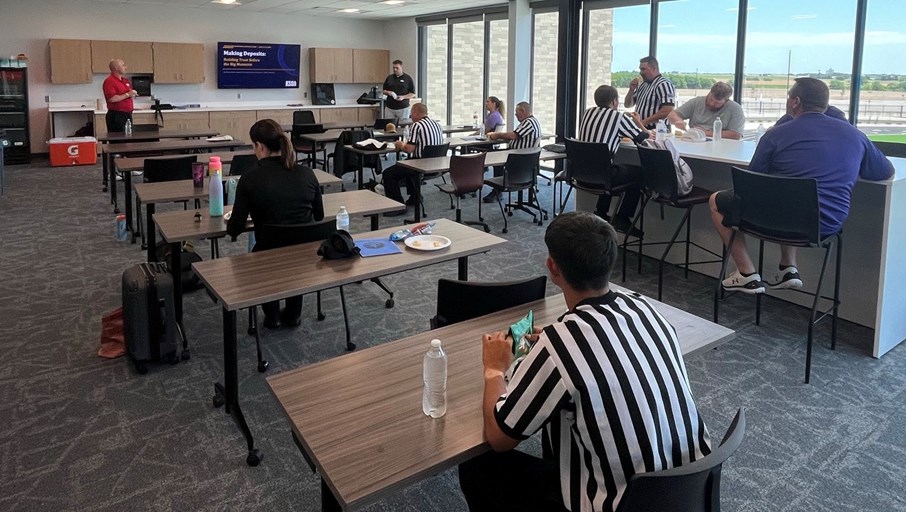 State officials have expanded opportunities through video presentations to learn specific skills or areas to hone their craft
Goodheart said KSHSAA has begun to offer weekly engagements and video content in various sports that can enhance the training process. Such tools are also a way to keep retired officials engaged in the development of their successors after they no longer are able to officiate.
KSHSAA has partnered with RefMasters, an online platform that offers content and creates dialogue not only among officials, but coaches, athletes and fans to improve the understanding of the game in every aspect. The service can provide specific areas of instruction if an official is seeking to improve different aspects of their craft they feel need attention – that instruction provided by high-level officials in the various sports.
“If Scott Goodheart really stinks at mechanics, he can get algorithms that lead back into it where he can find a clip that will help him with those mechanics,” Goodheart said. “We did a soft roll out last basketball season and there was some kickback, but there was a lot of ‘This is something we want.’ We feel like with the next generation of officials, we have a group of people that say that they want to get better. We want to help them to be doing that.
“This is a good way to evolve with the times because the games have changed a lot in the last five, 10, 20 years. We have to evolve with the game and this is the big piece of that.”
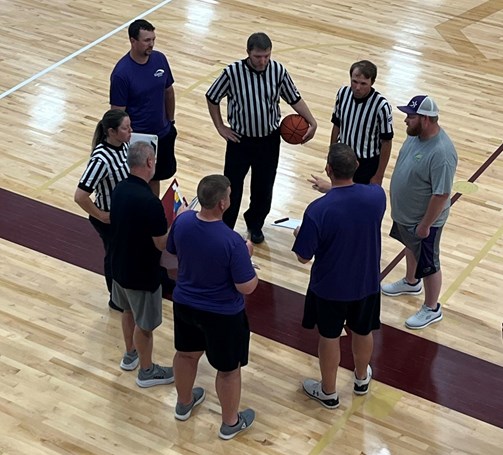 Hands-on learning experiences at scrimmages and camps has been beneficial in helping officials get real-time opportunities to improve.
In addition to those opportunities, Goodheart has put an emphasis on officials engaging in learning opportunities at the numerous youth sports events that occur in the offseason from their high school seasons. Just as kids and coaches are putting in work during the offseason, so too are officials encouraged to do the same – something Goodheart said also will improve the relationships officials have with the coaches and athletes they officiate.
“My perspective has been that since we’ve started doing these in-person trainings is that people are appreciative that there are official trainings,” he said. “Kids are playing year-round, what are we doing as officials to sharpen ourselves? I think when people see officials putting in work in the offseason, they’re appreciative of it. When they see there’s training going with it, it goes a long ways. That’s been my perspective on it. Coaches are putting in the work, kids are putting in the work and officials are doing the same thing. There’s that mutual respect that says you’re putting in the work and we are too.”
In addition to the shift in training and development, KSHSAA has also instituted a policy to where all registered sports officials must undergo a criminal background check. In the past, there was no such policy, but with such policies in place at both the youth and collegiate levels, Goodheart said it only made sense for that to be implemented at the scholastic level as well.
The cost for the background checks will be covered by KSHSAA.
“It’s been discussed for awhile and we were trying to find a way of doing it and keeping the cost down for officials,” he said. “We’re in a day and age where if you can’t work a youth game or a college game, why are you working high school? We’re trying to put the best product out there for our kids and membership and do things the right way.”